
Monica K. Hurdal
Contact Information
About
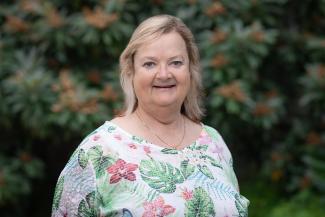
Monica Hurdal is a professor of biomedical mathematics in the Department of Mathematics at Florida State University. Her research involves investigating, modeling and visualizing information related to the way the human brain functions. Sources of data include, but are not limited to, magnetic resonance imaging scans and electroencephalography data. In the past she has been a visiting professor at the Mathematical Biosciences Institute at Ohio State University and in the Center for Imaging Science at Johns Hopkins University, where she typically spends a few weeks to a few months each year. From 1998-2006 she was also a member of the International Neuroimaging Research Consortium which received funding from the National Institutes of Health Brain Research through Advancing Innovative Neurotechnologies Initiative.
For the last few years she has been working on developing mathematical models of the developing brain using Turing systems as the basis for pattern formation of the sulci, or valleys, and gyri, or folds, of the brain. Her lab has been developing these models to investigate parameters that influence folding pattern formation of the brain. In turn, these parameters provide indicators that may be indicative of factors that contribute to folding pattern diseases of the brain including lissencephaply, lack of folds, and polymicrogyria, excessive folds. These models are providing information and hypotheses that guide neuroscientists in developing experiments to test the validity of these models and their implications in brain disease.
Another project Hurdal is working on involves creating a flat map of the brain. She has worked with De Witt Sumners and Phil Bowers of the FSU Department of Mathematics, and Ken Stephenson of the University of Tennessee, Knoxville on the mathematical and computational aspects of this research. Their approach is to try and create a conformal flat map of the brain. The advantage of this approach is that a conformal map is mathematically unique and requires no cuts in the surface. In addition, a conformal map preserves angular proportion. Hurdal has obtained MRI data from some of her previous collaborators including David Rottenberg of the Minneapolis VA Medical Center, and Michael Miller and Tilak Ratnanather of the JHU Center for Imaging Science.
human brain mapping, cortical folding